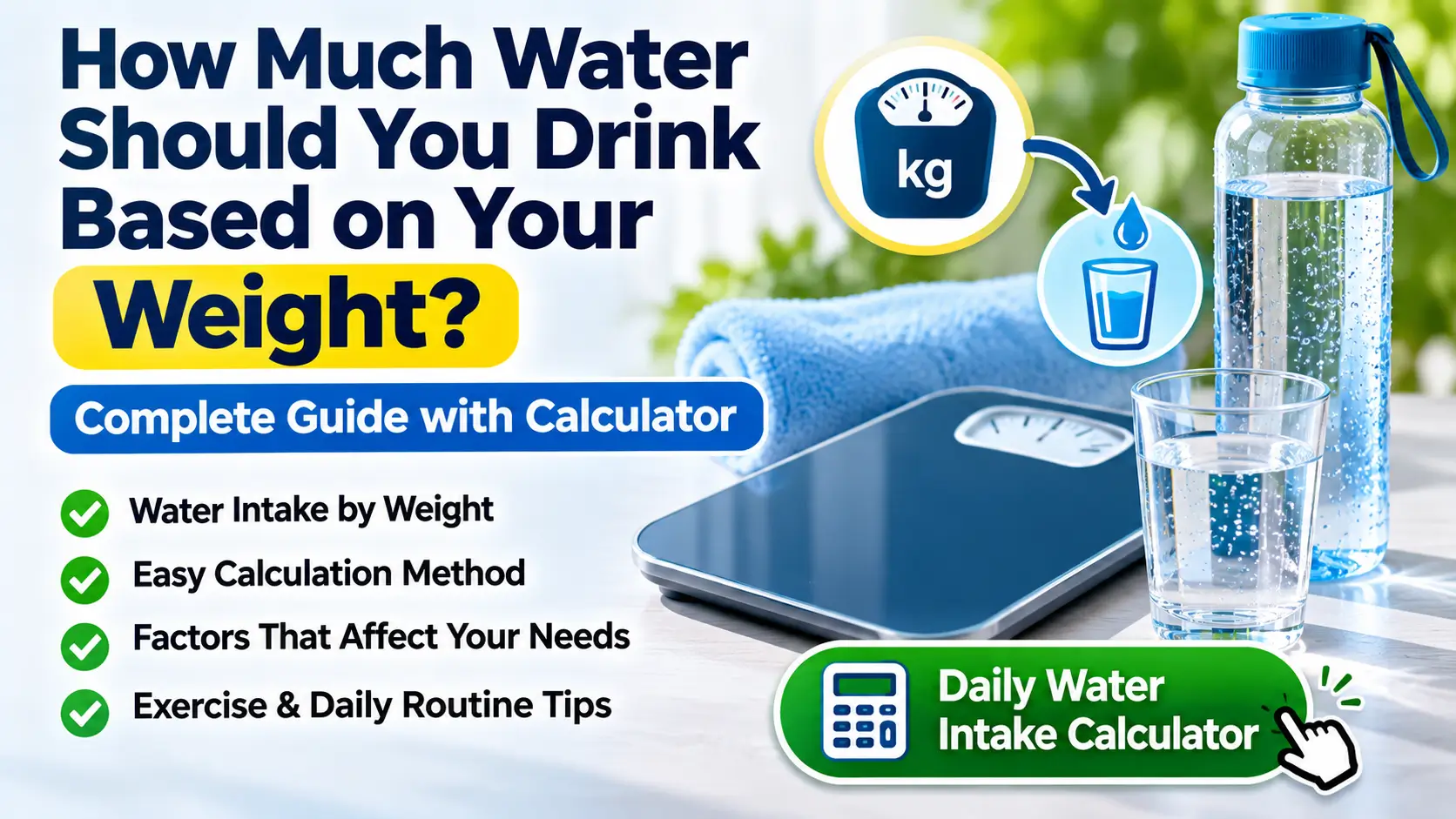
How Much Water Should You Drink Based on Your Weight?
How much water should you drink based on your weight? Body weight is one factor that can help estimate your daily fluid needs, but it is not the only factor that matters. A Daily Water Intake Calculator can use your weight along with other personal details to give you a more useful estimate.
Your body needs water every day for normal functions. You lose fluids through sweating, breathing, urination, and other everyday processes. The amount you need to replace can change from one person to another.
A person who weighs more may generally need more fluid than someone who weighs less. However, two people with the same weight can still have different water needs because of their activity level, diet, age, weather, and daily routine.
Why Body Weight Matters for Water Intake
Body size can influence how much fluid your body needs. This is one reason weight is commonly included in water intake calculations.
For example, a person who weighs 50 kg and a person who weighs 90 kg should not automatically be expected to drink exactly the same amount of water every day.
However, weight should not be used as a strict rule. It provides a starting point for an estimate rather than a perfect answer.
Your daily water needs can increase when you exercise, sweat heavily, spend time outdoors, or live in a hot environment. They may be different on a cool day when your activity level is lower.
This means a weight-based estimate should be viewed as a guide that can be adjusted according to your daily circumstances.
Water Intake by Weight
There is no single official amount of water that every person should drink based only on body weight. Different formulas can produce different estimates, and individual needs can vary.
A simple way to understand the relationship is that body weight can provide a baseline for estimating fluid requirements.
| Body Weight | General Approach |
|---|---|
| Lower body weight | Usually requires less fluid than a larger body |
| Medium body weight | Moderate fluid needs |
| Higher body weight | May require more fluid |
| Any body weight with heavy exercise | Additional fluids may be needed |
| Any body weight in hot weather | Fluid needs may increase |
This table is intended to explain the relationship between body weight and hydration, not to provide a fixed prescription.
Your actual fluid intake should also take into account how active you are and how much fluid you get from food and other beverages.
If you have specific medical instructions about fluid intake, those instructions should take priority over a general calculator or weight-based estimate.
How to Calculate Water Needs by Weight
Many hydration calculators use body weight as part of their calculation. The basic idea is straightforward: enter your weight and other personal information, and the calculator provides an estimated daily amount.
Some online methods use a fixed amount of fluid per unit of body weight. These methods can be useful for creating a rough estimate, but they should not be considered a universal medical rule.
For example, imagine two people with the same body weight. One works indoors and has little physical activity, while the other spends several hours exercising outside.
Their water needs may not be identical because the second person may lose more fluid through sweating.
This is why using weight alone can be misleading.
A better approach is to combine weight with other relevant information. This is where a Daily Water Intake Calculator can be useful.
Instead of manually applying a formula, you can enter your personal details and receive an estimate based on the information requested by the calculator.
The result can then be used as a practical starting point for planning your daily hydration routine.
Does Height Affect Water Requirements?
Height can be another useful piece of information when estimating water needs, especially when it is considered alongside weight.
However, height by itself does not tell you exactly how much water you should drink.
Two people can have the same height but different body weights, activity levels, and lifestyles. Their daily fluid requirements may therefore be different.
Height is more useful when it forms part of a broader personal profile.
For this reason, some calculators ask for both height and weight. These details can help provide a more personalized estimate than using a single number.
Your age, gender, activity level, and other factors may also be included depending on how the calculator is designed.
The important point is that no single measurement can perfectly determine your daily water requirement.
Factors That Can Increase Your Water Needs
Your weight provides only part of the picture. Several everyday situations can increase the amount of fluid your body needs.
Exercise
Physical activity can cause you to sweat and lose fluids. The longer and more intense your activity, the more attention you may need to give to hydration.
People who exercise regularly should keep water available during their workouts and replace fluids after physical activity.
Hot Weather
Hot temperatures can increase sweating, especially when you spend a lot of time outdoors.
On hot days, you may need to drink more frequently than you would during cooler weather.
Outdoor Work
People who work outside may lose more fluid because of heat, physical activity, and sweating.
Construction workers, agricultural workers, delivery workers, and other outdoor workers may need to pay particular attention to regular fluid intake.
Heavy Sweating
Some people naturally sweat more than others during exercise or physical work.
If you lose a significant amount of fluid through sweating, your normal daily estimate may not be enough for that particular situation.
Diet
Food also contributes to your overall fluid intake.
Fruits and vegetables can contain a considerable amount of water, while other foods contain less. Your eating habits can therefore affect how much fluid you receive from food during the day.
Illness
Fluid needs can change during some illnesses, particularly when there is increased fluid loss.
If you are sick or have a medical condition that affects hydration, follow advice from a qualified healthcare professional rather than relying only on a general water calculator.
How Much Water Should You Drink During Exercise?
Exercise can change your hydration needs because your body may lose water through sweat.
There is no single amount that every person should drink during exercise. The right amount depends on the duration and intensity of the activity, the temperature, and how much you sweat.
For shorter and less intense activities, drinking water regularly throughout the day may be enough for many people.
Longer or more demanding workouts require greater attention to fluid replacement.
Instead of trying to drink a huge amount at once, take fluids regularly. This can make it easier to maintain hydration during physical activity.
After exercise, continue drinking fluids as part of your normal routine.
If you exercise in very hot conditions or participate in prolonged endurance activities, your hydration needs can be more complicated. In these situations, professional guidance can be useful.
Can You Drink Too Much Water?
Yes. Drinking an excessive amount of water can be harmful.
The goal of hydration is not to drink as much water as possible. Your body needs an appropriate balance of fluids, and consuming very large amounts in a short period can interfere with that balance.
This is another reason not to treat a calculator result as a target that must be exceeded.
If your calculator estimates a certain daily amount, you do not need to force yourself to drink significantly more just because you think more water is healthier.
A consistent and sensible hydration routine is a better approach.
People with certain medical conditions may also have specific fluid requirements. If a healthcare professional has given you a fluid restriction or another hydration plan, follow that guidance.
Daily Water Intake Calculator
A Daily Water Intake Calculator can make estimating your daily fluid needs much easier.
Instead of looking at weight alone, the calculator can ask for several details, such as age, gender, weight, and height.
Once you enter the required information, the tool provides an estimated daily water intake.
The result is not a diagnosis or a medical prescription. It is simply a convenient estimate that can help you understand your general hydration needs.
You can use the estimate as a starting point for building a daily routine.
For example, you could divide your estimated intake across the morning, afternoon, and evening rather than trying to consume it all at once.
Remember that your needs can change from day to day.
A hot day, long workout, or physically demanding job may require more attention to fluid replacement than a quiet day spent indoors.
How to Use a Daily Water Intake Calculator
Using the calculator is usually simple.
Enter your age, gender, weight, and height when requested. Make sure you use the correct units so the result is calculated properly.
After submitting your information, review the estimated daily amount.
You can then use that number as a general guide for your daily hydration habits.
The most important thing is consistency. Drinking water regularly is more practical than waiting until the end of the day and trying to consume a large amount.
Final Thoughts
Your body weight can provide a useful starting point for estimating how much water you need each day, but it should never be the only factor you consider.
Activity level, weather, diet, age, height, sweating, and your individual circumstances can all influence your fluid needs.
A Daily Water Intake Calculator brings several personal details together to provide a more useful estimate than simply following a fixed number of glasses.
Use the result as a guide rather than a strict requirement. Adjust your fluid intake when your activity or environment changes, and pay attention to your body’s normal signals.
The goal is simple: maintain a consistent hydration routine without turning water intake into a rigid daily target.